

Stabilizers can reduce the interfacial tension between the dispersed phase and the continuous phase, preventing droplet coalescence. Their concentration needs to be controlled within a reasonable range.
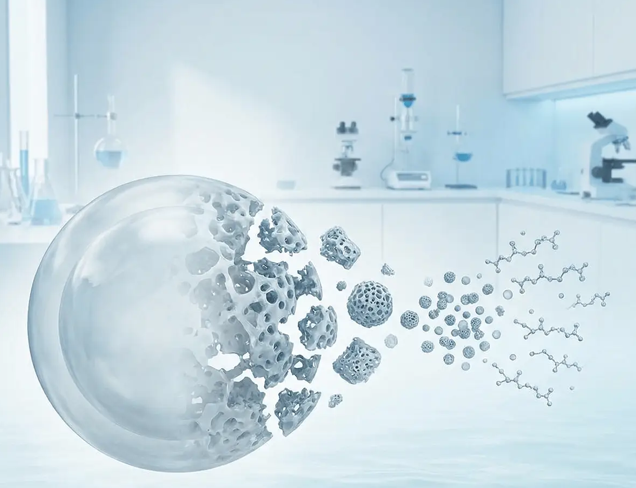
1. Stabilizer concentration: Stabilizers can reduce the interfacial tension between the dispersed phase and the continuous phase, preventing droplet coalescence. Their concentration needs to be controlled within a reasonable range. If the concentration is too low, droplet stability is poor, making them prone to coalescence and agglomeration; if the concentration is too high, it increases the system viscosity, affecting droplet formation and microsphere morphology. For example, when preparing PLGA microspheres, controlling the stabilizer concentration at 1.0% (w) can yield microspheres with smooth surfaces and uniform particle size.
2. Polymer Concentration: Taking the preparation of polymer microspheres as an example, the polymer concentration directly affects the viscosity of the dispersed phase. A too high concentration can lead to difficulties in droplet formation, resulting in larger and unevenly distributed particle sizes; a too low concentration can cause droplets to easily break, affecting the integrity of the microspheres. For instance, when preparing PLGA microspheres, controlling the PLGA concentration at 60mg/mL can achieve a good balance between particle size uniformity and microsphere morphology, resulting in smooth-surfaced microsphere products.
We are committed to providing advanced laboratory and research services that meet the highest standards of quality and precision.

Copyright © 2026 Yantai Shenghua Biotechnology Co., Ltd.