

In the chemical, pharmaceutical, and daily chemical industries, the particle size uniformity of emulsions directly affects product performance and stability. Traditional emulsification technologies often face problems such as wide particle size distribution, large batch-to-batch variations, and high energy consumption. However, the emergence of membrane emulsification technology, with its core advantages of "low cost + high precision," has become the preferred solution for preparing monodisperse emulsions. This article will provide a comprehensive understanding of this new emulsification technology from the aspects of principle, advantages, equipment, and applications. I. Core Technology: Precise Particle Size Control

In the chemical, pharmaceutical, and personal care fields, the uniformity of emulsion droplet size directly affects product performance and stability. Traditional emulsification technologies often suffer from wide particle size distribution, large batch‑to‑batch variation, and high energy consumption. Membrane emulsification, with its core advantages of “low cost + high precision”, has therefore become a preferred solution for producing monodisperse emulsions. This article provides a comprehensive overview of this new emulsification technology from the perspectives of principles, advantages, equipment, and applications.
I. Core Technology: Emulsification Principle for Precise Size Control
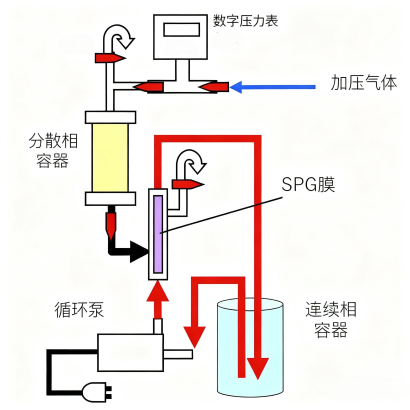
The core logic of membrane emulsification is to achieve uniform droplet formation through the “sieving effect” of a microporous membrane. Under nitrogen pressure, the dispersed phase passes through the uniform fine pores of the membrane and initially forms droplets on the membrane surface. As the flowing continuous phase sweeps across the surface, the droplets detach once they reach a specific size, ultimately forming an emulsion.
The key advantage lies in its “controllability”: droplet size is directly related to the membrane pore size. By changing to membranes with different pore sizes, the emulsion droplet size can be precisely tuned. At the same time, the uniform pore size distribution of the membrane ensures monodispersity at the source. Combined with optimization of the continuous phase composition, droplet stability can be further improved, laying a solid foundation for subsequent preparation of polymer particles.
II. Key Technical Advantages: Four Highlights Addressing Traditional Pain Points
Compared with traditional emulsification technologies, membrane emulsification delivers multiple breakthroughs in performance and practicality:
Excellent droplet size uniformity: the coefficient of variation can be controlled within 10%, far superior to traditional technologies, ensuring stable product quality;
Wide controllable droplet size range: by adjusting the membrane pore size, emulsions in the range of 0.1–150 μm can be produced to meet requirements of different application scenarios;
Strong batch‑to‑batch consistency: batch variation can be controlled within 6%, meeting the uniformity requirements of large‑scale production;
Broad system compatibility: applicable to all emulsion systems, including O/W, W/O, W/O/W, and O/W/O types, with no limitation on application scenarios.
III. Two Emulsification Modes: Flexibly Matching Different Scenarios
Membrane emulsification offers two core emulsification modes that can be flexibly selected according to production needs:
Direct emulsification: the dispersed phase and continuous phase are placed in separate vessels. The dispersed phase passes through the microporous membrane to form droplets, and the final droplet size is about 3–4 times the membrane pore size (for example, a 1 μm pore corresponds to approximately 3.0 μm droplets, and a 20 μm pore corresponds to approximately 66.2 μm droplets), making it suitable for scenarios with stringent requirements on droplet size precision;
Premix emulsification: the dispersed phase and continuous phase are premixed and then pushed together through the microporous membrane. The resulting droplet size is about 1–2 times the membrane pore size. This mode offers higher emulsification efficiency and is better suited for batch production.
IV. Equipment Portfolio: Full‑Chain Coverage from Lab to Industrial Scale
To satisfy needs at different stages, membrane emulsification equipment has evolved into a complete product system:
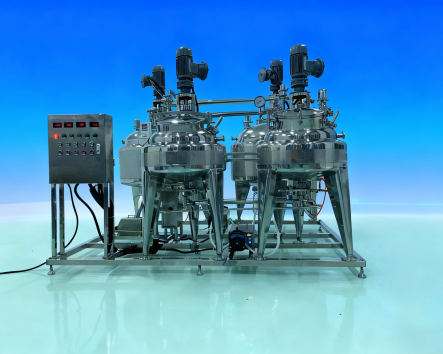
High‑speed membrane emulsifier: adopts an external‑pressure design, with the dispersed phase outside the membrane and the continuous phase continuously flowing via pump. Nitrogen pressure directly acts on the outside of the membrane to enable automatic continuous processing. The membrane specification is Φ10 × L125 mm (effective length 105 mm), suitable for pore sizes ≥0.1 μm; maximum pressure 900 kPa; dispersed phase volume 200 mL; continuous phase volume from 300 mL to several liters. It is the core device for laboratory‑scale trials;
Pilot‑scale and scale‑up equipment: supports customization on demand. Leveraging extensive scaling‑up experience, it enables seamless transition from laboratory formulations to industrial‑scale production, meeting the large‑scale manufacturing needs of chemical, pharmaceutical, and other industries.
V. Broad Applications: Enabling Product Innovation Across Multiple Fields
Membrane emulsification can be used to prepare emulsions, beads, microspheres, microcapsules, and other products with uniform size, enabling precise control over particle size, surface functional groups, and porous structures. It is widely used in chemicals (polymer synthesis), food (probiotic encapsulation), personal care (cosmetic texture optimization), pharmaceuticals (drug sustained‑release microcapsules), and biochemical separation (preparation of chromatography media), providing a core technical driver for product upgrades.
If you are looking for a high‑precision, stable, and reliable emulsification solution, whether for laboratory R&D or industrial production, we can provide customized equipment and technical support. You are welcome to contact us and explore more application possibilities of membrane emulsification technology!
We are committed to providing advanced laboratory and research services that meet the highest standards of quality and precision.

Copyright © 2026 Yantai Shenghua Biotechnology Co., Ltd.